English
At Burnside Primary School, we believe that literacy and communication are fundamental life skills. Through our rich, ambitious English curriculum, we empower children to develop the knowledge and confidence to communicate effectively and creatively with the world around them through spoken and written language.
By cultivating a vibrant reading culture, we ensure that all pupils develop a profound appreciation for literature—discovering books as "portable magic" that can transport their imagination, deepen their understanding, and foster a lifelong love of learning.
Our English curriculum is explicitly structured around our school motto: Be safe, be smart, be kind, ensuring every pupil is supported to thrive, achieve, and belong.
How English Reflects Our Values
-
Be Safe: Reading and writing provide powerful avenues for emotional expression, wellbeing, and reflection. Through carefully chosen literature, children explore complex emotions, learn to navigate challenging situations, and develop self-regulation in a secure, supportive classroom environment where they feel safe to thrive.
-
Be Smart: We build strong, sequential knowledge across reading comprehension, phonics, grammar, spelling, and composition. By analysing high-quality texts and mastering foundational language structures, pupils develop the critical thinking and articulate expression required to achieve academic excellence.
-
Be Kind: Books offer a window into diverse cultures, historical perspectives, and human experiences. Through rich literature, including our focus on inclusion and the "No Outsiders" framework, pupils build deep empathy, broaden their perspectives, and learn to value every individual, cultivating a true sense of belonging.
Core Pillars of Our English Curriculum
Our English curriculum seamlessly integrates reading, writing, and oracy to build cumulative, lifelong literacy skills:
-
Reading & Literature: We prioritise early reading through systematic synthetic phonics, transitioning into rich reading comprehension as children progress. Pupils are exposed to a wide variety of high-quality fiction, non-fiction, poetry, and classical literature that reflect diverse voices, cultures, and global issues.
-
Writing & Composition: Children are taught to write purposefully for a range of audiences and genres. We emphasise explicit teaching of spelling, punctuation, and grammar (SPaG), sentence construction, and the recursive processes of planning, drafting, editing, and publishing.
-
Oracy & Spoken Language: Quality talk underpins all English learning. Children are taught to articulate their thoughts clearly, engage in respectful debate, recite poetry, and perform drama, ensuring that spoken language acts as a bridge to confident written expression.
Literature-Led Learning
Carefully selected texts lie at the heart of our curriculum. Books are chosen to align with our whole-school ethos, allowing pupils to reflect on their personal wellbeing, local heritage, global community, and future aspirations. Through shared reading experiences, our pupils develop a strong voice, a rich vocabulary, and the knowledge needed to succeed in secondary school and beyond.
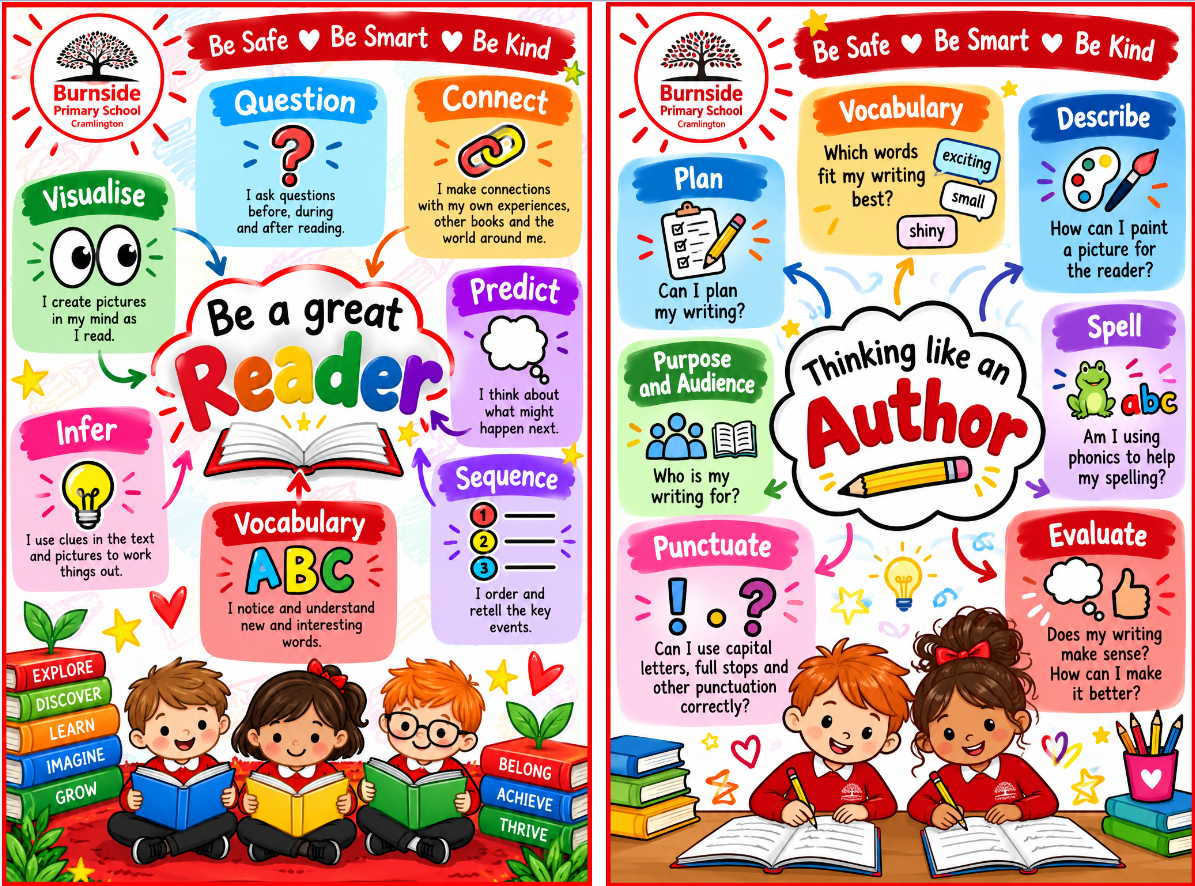
With this all combined, we aim to ensure our children leave Burnside Primary School with a solid foundation in the spoken and written word, having had the opportunity to master these essential life skills.
As a school, we aim to promote high standards of language and literacy by equipping children with a strong command of the spoken and written word, and developing their love of literature through widespread reading both across the curriculum and at home. We aim to ensure that all pupils are supported to thrive, achieve, and belong, enabling them to:
-
Read easily, fluently, and with age-appropriate speed and expression.
-
Develop strong comprehension skills, drawing on mental models and prior knowledge to make sense of what they have read.
-
Foster a genuine love of reading and the habit of reading widely and often, for both pleasure and information.
-
Acquire a rich and varied vocabulary, a firm understanding of grammar, and knowledge of linguistic conventions for reading, writing, and spoken language.
-
Appreciate our rich and varied literary heritage, including works from local, national, and global authors.
-
Write clearly, accurately, and coherently—adapting their language and style for a wide range of contexts, purposes, and audiences.
-
Use purposeful discussion in order to learn, elaborating on and explaining clearly their understanding and ideas.
-
Become competent in the arts of speaking and listening, making formal presentations, demonstrating to others, and participating constructively in debates.
Curriculum Structure
At each key stage, a detailed programme of study sets out what pupils should be taught, fully aligned with the National Curriculum for England.
Reading
The programmes of study for reading across Key Stage 1 and Key Stage 2 focus on two core dimensions:
-
Word Reading: Developing fluent decoding through systematic synthetic phonics and automatic recognition of high-frequency words.
-
Comprehension: Developing deep understanding, inference, and critical analysis through both listening to and reading high-quality texts.
Writing
The programmes of study for writing are structured around two complementary strands:
-
Transcription: Developing accurate spelling, phonics application, and fluent, legible handwriting.
-
Composition: Articulating ideas clearly and structuring them effectively in both spoken language and written prose.
Spelling, vocabulary, and grammar are seamlessly embedded across our programmes of study. Opportunities for staff to enhance pupils’ vocabulary arise naturally through shared reading and writing experiences, providing a language-rich environment where every child's literacy skills can flourish.
Spoken language underpins the development of both reading and writing across the entire curriculum—cognitively, socially, and linguistically. At Burnside Primary, we actively cultivate these foundational skills in English lessons and across all subject areas so that every pupil can express themselves with confidence, clarity, and pride.
National Curriculum Links:
To learn more about statutory outcomes, view the National Curriculum: English Programmes of Study.